My Grandmother’s Cat

Garrison Keillor 1983

A Prairie Home Companion

My grandmother’s cat was too large for a shelf
so he slept every night in a bed
He was almost as big as my grandma herself
because three times a day he was fed
He was fed tuna scraps as he sat in my grandma’s lap
on his back with his big napkin tied
He ate – as – much as he could hold
’til he got – too – wide

Chorus 1:
Every day piles of chicken parts
Mouse morsels a la carte
He ate – as – much as he could hold ’til he got – too – wide

My grandmother said that of cats she had known,
her favorite by far was old Dan
He sat by her side and his eyes simply shown
when she opened the tuna fish can
With his eyes shining bright and a grown of delight
he would brush against grandma and purr
But one – day – he knocked grandma down
because he was now bigger than her

Chorus 2:
Every day piles of salmon meat
Sirloin of parakeet
But one – day – he knocked grandma down because he was now bigger than her

She fell to the floor with a pitiful scream
and lay there unconscious a while
When she awoke his eyes were agleam
as he looked down on her with a smile
With his gigantic paw he pinned my old grandma
as he gave her a horrible grin
He looked – at – her legs and her arms,
wondering where to begin

Chorus 3:
Every day, gobs of goose pate
Big plates of fish filet
He looked – at – her legs and her arms, wondering where to begin

She managed to climb despite her bad back
to the top of her old Frigidaire
She threw him two steaks, his favorite snack,
which he always took medium-rare
Those three days which she spent up on the fridge
seemed to her like a lifetime at least
She threw – down – all the food she had
to fill up that ravenous beast

Chorus 4:
Burgers and cottage fries
Hams of the family size
She threw – down – all the food she had to fill up that ravenous beast

She fed him three days ’til she ran out of stuff
and the giant was begging for more
He was standing and nibbling at her little pink scuff
when the family burst in through the door
It took twenty men to shove him in a pen
and we shipped him away to the zoo
Let this – be – a lesson to us all
that your cat should be smaller than you

Chorus 5:
Carte blanche you can’t afford
Cut out the smorgasbord
Let this – be – a lesson to us all that your cat should be smaller than you 
Mount and Go

trad 

Archie Fisher recorded in 1976 on The Man With a Rhyme, where he writes "The Greig manuscript gave us one of the few songs where the woman comes off the better. In this case, she escapes a fixed marriage with a rich sea Captain, apparently taking his ship as well as his gold."

My parents married me ower young
To an auld carle baith bald and dumb.
His love was done and mine new sprung,
So I’ll fly the plains wi’ my laddie O.

Chorus:
Come, bonnie laddie, mount and go,
Hey, bonnie laddie, mount and go,
Come, bonnie laddie, mount and go,
Mount and I’ll gang wi’ ye O.

But I would leave my good peat stack,
And so would I my good kailyard,
So would I my auld bald laird
To fly the plains wi’ my laddie O.

And when the auld carle lay fast asleep,
Out of his arms she did quickly creep,
And the keys o’ the cabin she did keep,
And she’s flown the plains wi’ her laddie O.

The auld carte wakened in the ha’;
The sheets were cold and she was awa’.
Wi’ the weight o’ herself in goud and a’
She’s flown the plains wi’ her laddie O.

“It’s ye’ll gang doon tae yon seashore,
And ye’ll see a ship where she was afore;
Ye’ll speir at the skipper if she’s been there,
Or if any of his sailors saw her O.”

And as she sailed out ower yon lea,
She drank a toast right merrily.
She’s thrown the wine glass intae the sea,
For joy she has found wi’ her laddie O.

When she landed ower yon lea,
She was lady o’ fifty ploughs and three,
Lady o’ fifty ploughs and three
And she dearly lo’es her laddie O. 

More Wood

Dillon Bustin 1975

In the fall of the year, when you feel the winter near
And the days are clear It surely isn’t good to
sit by the fire And want to stoke it higher
When you should be cutting more wood.
From November to march, the winter winds are harsh
On the fields and the marsh they’re covered up with snow
When you trudge to the shed you have to scratch your head
Because the dad-blamed pile’s getting low on

Chorus:
Wood (hard wood) Firewood (dry wood)
There’s not a stove in the world That’s going to do you any good
Without wood (stove wood) We could (you should)
Be out cutting more wood.

When the kindling is dwindling, the bottom logs get soggy
Those ricks of sticks and racks and stacks It makes you wonder where they go
and barnfuls of armfuls They only last a week or so
And then you’ll be hurting for wood.
Well the sassafras it burns too fast, It starts the fire but never lasts
And swamp oak likes to smoke you blow it till you think you’ll choke.
But hickory is just the tree to remind you of the ecstasy
Of having a pile of good wood, I said

Well the Scandia and Jotul brands are made so far across the sea
Vermont Castings and Timberline are made here in the country
With all the rest put to the test the one I like the best
Is the one my Uncle Wade he made for me.
He took an oil drum and welded some piping from the septic tank
And fore and aft he cut a draft, and then he made a damper crank
With an old broom from the back room.
He painted it fire engine red And said now watch her consume your

When the spring rolls around and I spade the muddy ground
I have often found I lay my saw away, The shed is
empty and yet you can make a bet
That I’ll forget to be cutting more wood.
The old timers say to split a little every day
And stack it away to season well, but
From March to November I rarely do remember
December will find me in a rut

Last Chorus:
Without wood (hard wood) Firewood (dry wood)
There’s not a stove in the world That’s going to do you any good
Without wood (stove wood) We could (you should)
Be out cutting some
Throw it in the oil drum
What do you think your saw is for
You can always use some more wood. 

More Waters Rising

Saro Lynch-Thomason 2016

"This is a song that I created back in March 2016 when the HB2 bill was passed here in North Carolina. Now in the early days of the Trump administration, this song feels deeply resonant. For me, this song is about seeing what's coming on the horizon: harder times that are inevitable and unavoidable. But the answer to the fear of what's coming is resiliency and claiming a strength within ourselves that has been there all along. Aspects of this song are inspired from elements of African-American Civil Rights and protest songs. This song is meant to be sung in groups. Please share this song, use it at protests, use it in church, use it in meetings, add new verses, spread it around!"

There are more waters rising, This I know, This I know.
There are more waters rising, This I know.
There are more waters rising, They will find their way to me.
There are more waters rising, This I know.

There are more fires burning…

There are more mountains falling…

I will wade through the waters…
I will wade through the waters, When they find their way to me…

I will walk through the fires…
I will walk through the fires, When they find their way to me…

I will rebuild the mountains…
I will rebuild the mountains, When they find their way to me…

More Than Enough

Robb Johnson 1993

There’s always the money for missiles & tanks
There’s always the money for generals & banks
There’s always the money for new ways to kill
But a limited budget for you if you’re ill
Yes there’s always enough for a war
But there’s never enough for the poor

There’s always the money for tunnels and roads
For opera and ballet, but not jobs and homes
For MPs’ expenses & fat subsidies
But there’s never the money for nurseries
And the well-off they always take more
So there’s never enough for the poor

There’s always the money for tests they can pass
Or fail you for not being white middle class
There’s always the goodies for those with most greed
But never enough for those in most need
There’s a pay-rise if you’re on the board,
But there’s never enough for the poor

Consider the little of life that we know
We bring nothing, take nothing, pass through and go
We’re all of us poor when it comes to the night
In need of the darkness, in need of the light
If we learned to want less and love more
There’d be enough for the poor 

Molasses Rum

Tom Rowe 1985

The Great Molasses Flood of 1919 in Boston killed 21 and injured 150. Molasses was made into alcohol but also munitions, and was sent from this harbor storage tank to a processing plant in Cambridge by a pipeline. The company may have been racing against Prohibition, which was passed the following day and effective one year later. The 50ft tall tank had leaked since being built 4 yrs earlier, and multiple components were too weak even by the standards of the time. Fermentation in the tank may have increased the pressure, as did a rapid increase in temperature caused by warm January weather and by a new shipment filling up the tank. 13,000 tons of molasses burst from a storage tank and flowed at 35 mph through the streets.

Oh, the African man cuts the sugar cane (Oh, molasses!)
He works in the sun and he works in the rain (Oh, molasses rum!)
Then he loads it up on a wooden ship
and he sends it off on a northern trip

Chorus:
Singing, oh molasses, oh molasses rum
Oh, molasses Old New England tea
It killed my grandpa, killed my pa
And it sure as Hell is killing me
Singing, oh molasses, oh molasses rum

When they fought the war for the colonies
They fought it over New England tea
When Old King George put a tax on it
the colonies nearly took a fit

In the time of the 1917 war
Molasses sitting on the Boston shore
When they pumped it in it was twelve degrees,
a long cold night in a Boston freeze

In the morning it was 42
Molasses vat split clean in two
Two million gallons covered the bay,
26 people drowned in the flood that day

My grandpa he died cutting cane
My pa went down in the great brown rain
But I won’t go in a pool of blood,
no I won’t drown in a black-strap flood
Still, I’ll go down to molasses, oh molasses rum 

Mister Weather

Nancy Kerr 2019

Inspired by removal of trees from Sheffield's streets; celebration of altruistic human spirit in the face of adversity. 5000-6000 trees felled in 2014-2018 before community pushback stopped it.

Nancy Kerr & James Fagan: https://kerrfagan.bandcamp.com/track/mr-weather

Good morning, Mister Weather, where will you spend the day?
I’ll kiss the elm of Nether Edge and blow her cares away
Good evening, Mister Weather, where is it that you go?
I shake the Pittsmoor cherries and we watch the blossom blow

Chorus:
And we’ll all hang on (Like the flowing of the sheaf)
And we’ll all hang on Together
And we’ll all hang on (Like the growing of a leaf)
And we’ll all hang on Together

Good morning, Mister Weather, why the heavy skies above?
There’s a willow by the Rother and I think it could be love
For I courted him in autumn, I clothed him in the spring
I loved him in the summer and in winter made him sing

Good evening, Mister Weather, where did you hide the sun?
She’s down behind the seven hills but still she isn’t done
For she shines on all the city and when I help her down
She shines within the heart of every lover in the town 

Mingulay Boat Song

Hugh Robertson 1938

Sir Hugh Roberton (1874-1952) was conductor of the Orpheus Choir of Glasgow for which he made many choral arrangements of Scots songs. Mingulay was a crofting and fishing community of about 160 people until 1912. Isolation, infertile land, lack of a proper landing place and the absentee landlord problems familiar to the Western Isles and Highlands, resulted in a gradual disintegration of Mingulay's culture. The process of voluntary evacuation began in 1907 with land raids by the impoverished crofters to the neighbouring island of Vatersay, and Mingulay is now completely deserted. But summer visitors to Barra regularly brave the two-hour journey in exposed seas from Castlebay to Mingulay, inspired by Roberton's evocative but sentimental song, which has no connection with either the island or its people. Ben Buxton's 2017 book about Mingulay says "neither the words nor the melody originate anywhere near Mingulay; it is a romantic invention of the 20th century. It was devised in 1938 by Glasgow-born Sir Hugh Roberton, who was very fond of the melody of 'Creag Ghuanach', a song from Lochaber, which celebrates a crag near Loch Treig. He needed a sea shanty, and so he adapted the music, chose the romantic name Mingulay, and composed the words."

Chorus:
Hill you ho, boys; let her go, boys;
Bring her head round, now all together.
Hill you ho, boys; let her go, boys;
Sailing home, home to Mingulay.

What care we though white the Minch is?
What care we for wind or weather?
Let her go, boys! ev’ry inch is
Wearing home, home to Mingulay.

Wives are waiting on the bank, or
Looking seaward from the heather;
Pull her round, boys! and we’ll anchor,
Ere the sun sets at Mingulay. 

The Miner’s Lifeguard

trad 

The Digital Tradition attributes it to Charles Davies Tillman with words anon., and says it is "an 1890ish parody on Life is Like a Mountain Railway, ca. 1870".

Miner’s life is like a sailor’s
‘Board a ship to cross the waves.
Ev’ry day his life’s in danger,
Still he ventures being brave.
Watch the rocks, they’re falling daily,
Careless miners always fail.
Keep your hand upon the wages
And your eye upon the scale.

Chorus:
Union miners stand together,
Do not heed the owner’s tale,
Keep your hand upon the wages,
And your eye upon the scale.

You’ve been docked and docked again, boys,
You’ve been loading two to four;
What have you to show for working
Since this mining has begun?
Worn-out boots and worn-out miners,
Lungs of stone and children pale.
Keep your hand upon your wages
And your eye upon the scale.

In conclusion, bear in memory,
Keep the password in your mind:
God provides for every worker
When in union they combine.
Stand like men and linked together,
Victory for you’ll prevail.
Keep your hand upon the wages
And your eye upon the scale. 

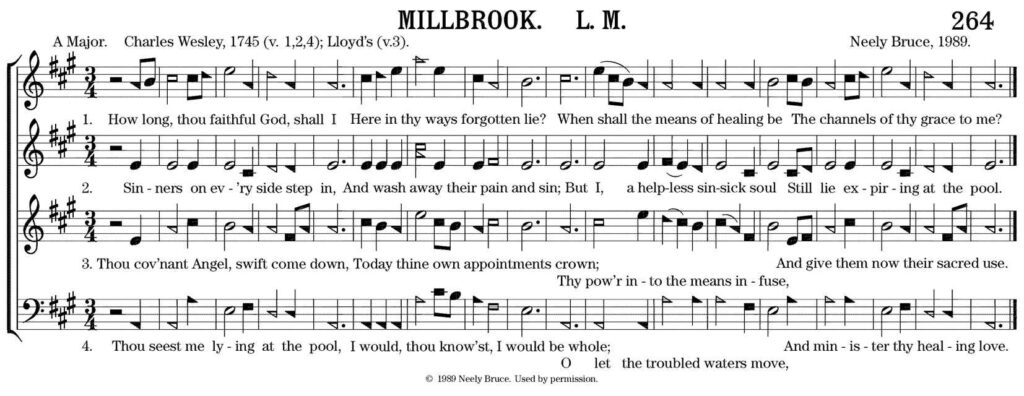
Millbrook

Neely Bruce 1989

How long, thou faithful God, shall I
Here in thy ways forgotten lie?
When shall the means of healing be
The channels of thy grace to me?

Sinners on ev’ry side step in,
And wash away their pain and sin;
But I, a helpless sinsick soul
Still lie expiring at the pool.

Thou cov’nant Angel, swift come down,
Today thine own appointments crown;
Thy pow’r into the means infuse,
And give them now their sacred use.

Thou seest me lying at the pool,
I would, thou know’st, I would be whole;
O let the troubled waters move,
And minister thy healing love.